Do you need a free government phone SIM card? A free government phone SIM card comes from approved providers of the federal Lifeline program.
Lifeline gives a monthly subsidy, and providers send a SIM card or eSIM so you can use talk, text, and data at no cost if you qualify. You can place the SIM in a compatible unlocked phone or activate eSIM instantly.
Read below to see who qualifies and how to apply.
1. What Is a Free Government Phone SIM Card?
A free government phone SIM card is either a physical SIM or a digital eSIM provided by approved providers of the federal Lifeline Assistance program.
It allows eligible low-income individuals to activate free monthly cellular service on a compatible phone. You can use the SIM in your own unlocked device and receive talk, text, and data without monthly bills or contracts.
Lifeline provides a monthly subsidy that reduces your phone service cost:
- USD 9.25 per month for most eligible households
- Up to USD 34.25 per month for eligible residents on Tribal lands
Lifeline allows one benefit per household.
1.1. Key Features and Benefits
When you receive a free government phone SIM card, you can receive:
- No monthly payment for the basic Lifeline plan
- Free talk and text, plus a set amount of monthly data (varies by state)
- Compatibility with your own unlocked phone
- Option to choose a promotional smartphone if you do not have one
- No contract and no credit check
- Access to service for work, school, and emergency communication
If you already own a supported device, you can activate service without buying a new phone.
1.2. Eligibility Criteria
You may qualify for a free government phone SIM card in two main ways.
Income-Based Eligibility
- Your household income is at or below 135% of the Federal Poverty Guidelines
Program-Based Eligibility
You participate in one of the following programs:
- SNAP (Food Stamps)
- Medicaid
- SSI
- Federal Public Housing Assistance (FPHA) or Section 8
- Veterans Pension or Survivors Benefits
Tribal Lands
Residents on Tribal lands may qualify under expanded eligibility rules and receive a higher monthly subsidy.
Most applicants complete the process through auto-verification. If the system cannot confirm your status, the provider may ask you to upload proof of your status.
>>> Read more: What Is The Best Free Government Phone For Low-Income People?
2. Which Are the Best Lifeline Providers in the US?
If you want a free government phone SIM card or eSIM, you must apply through an approved Lifeline provider.
Not all providers offer the same device options, approval speed, or customer support. Choosing the right company can reduce delays and confusion.
Before selecting a provider, understand the common challenges applicants face.
2.1. Challenges Applicants May Face
Many applicants experience problems during the Lifeline process. Most issues happen because of incomplete information or device incompatibility.
Common challenges include:
- Entering incorrect personal details that do not match official records
- Uploading unclear or expired documents
- Applying through unofficial or scam websites
- Choosing a provider that does not support service in their ZIP code
- Selecting a SIM when the phone is locked to another carrier
- Expecting premium phones to be available at all times
- Delays caused by manual eligibility review
You can avoid most problems by applying through a trusted provider, checking coverage first, and uploading clear documents.
2.2. Two Reliable Providers
Several Lifeline providers operate nationwide, but two companies stand out due to scale, inventory, and support systems.
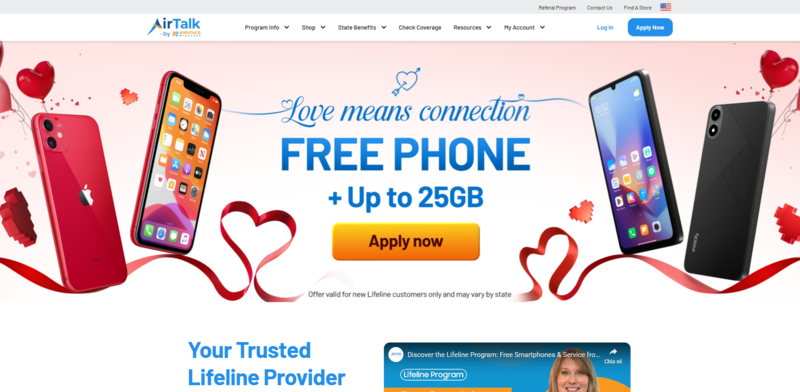
Cintex Wireless and AirTalk Wireless serve more than 1.3 million users nationwide. The provider offers both a free government phone plan with eSIM or a SIM Card in supported areas. Many applicants choose AirTalk because the website clearly shows plan details and device availability before submission.
Key features include:
- Free smartphone options (stock-based)
- BYOD (Bring Your Own Device) support
- Discounted 5G upgrade models
- Unlimited talk and text
- Data allowances that vary by state
- Enhanced Tribal benefits with larger monthly data
- Fast approval when auto-verification succeeds
- Free shipping within 3–7 business days
- Online order tracking
- 24/7 customer support
Note: Cintex Wireless is merging into AirTalk Wireless. Some applications now redirect to a unified platform. The combined system supports faster processing, broader device availability, and consistent service coverage.
Both providers offer enhanced Tribal plans with higher monthly data limits and increased subsidy support. Both companies also provide 24/7 customer service to assist before and after activation.
Before applying, compare plan details, data allowances, SIM compatibility, and coverage in your ZIP code to select the provider that fits your needs.
>>> Read more: Which Are the Best Free Gov Phone Companies in the US?
3. How to Get a Free Government eSIM? or SIM Card? (Step-by-Step)
You can apply for a free government phone eSIM or SIM card online through an approved Lifeline provider. The process is simple when you follow each step carefully.
Step 1: Check Your Eligibility
First, confirm that you qualify for the Lifeline program. You may qualify through SNAP, Medicaid, SSI, Veterans benefits, or income at or below 135% of the Federal Poverty Guidelines. If you live on Tribal lands, you may qualify for enhanced benefits.
Step 2: Visit the AirTalk Wireless Site
Go to the official AirTalk Wireless website. Enter your ZIP code to check local plans, coverage, and available device options. Plans and data allowances vary by state.
Step 3: Select Your Plan
Review available monthly plans. Most Lifeline plans include:
- Unlimited talk and text
- Monthly data allowance (varies by location)
- No contract
- No credit check
Choose the plan that fits your needs.
Step 4: Choose Phone or BYOD Option
You can select:
- A free smartphone (stock-based), or
- The BYOD (Bring Your Own Device) option if you already own a compatible unlocked phone
If your device supports eSIM, you can activate service digitally without waiting for shipping.
Step 5: Upload Documents (If Required)
Many applicants complete auto-verification. If the system cannot confirm eligibility, upload:
- A government-issued photo ID
- Proof of program participation or income
Upload clear images to avoid delays.
Step 6: Submit Your Application
Review your information and submit the form. Many users receive approval the same day when auto-verification succeeds. Manual review may take 1–3 business days.
Step 7: Receive SIM with Phone or Activate eSIM
After approval:
- If you selected a physical SIM with a phone, it ships within 7-14 business days.
- If you selected eSIM, you receive activation instructions by email and can activate service instantly on a compatible device.
Customer support is available if you need help during activation. Before applying, confirm your device compatibility and ZIP code coverage to avoid delays.
4. SIM Card vs eSIM: Which Should You Choose?
When you apply for a free government phone SIM card, you can usually choose between a physical SIM card or an eSIM. Both options give you Lifeline-supported service. The right choice depends on your phone and how quickly you need activation.
If you already own an older unlocked phone, a physical SIM card often works best. Most unlocked phones support a standard SIM card. You receive the SIM by mail and insert it into your device.
If you own a newer smartphone that supports eSIM, you can activate service without waiting for shipping. You scan a QR code or follow activation steps sent by email.
Below is a simple comparison.
| Feature | Physical SIM Card | eSIM |
| Activation Speed | 7-14 business days (after shipping) | Instant or same day after approval |
| Shipping Required | Yes | No |
| Device Compatibility | Works on most unlocked phones | Only supported on eSIM-compatible phones |
| Setup Method | Insert the SIM into the phone | Scan QR code or follow digital setup |
| Best For | Older phones, users not in a hurry | Newer phones, urgent activation |
If you need the service as soon as possible, eSIM is usually the better option. After approval, you can activate service within minutes on a compatible device.
Before choosing, check your phone model and confirm compatibility on the provider’s website. This step prevents delays and activation problems.
5. What Phone Can I Put My Government Phone SIM Card In?
You can place a free government phone SIM card into most unlocked GSM-compatible smartphones. Your phone must not be locked to another carrier.
Most providers support:
- iPhone models (iPhone 8 and newer typically work if unlocked)
- Samsung Galaxy devices (A series, S series, and newer models)
- Google Pixel phones
- Other unlocked Android smartphones that support 4G LTE or 5G
Before ordering a SIM card, check your phone’s IMEI number on the provider’s website. The IMEI check confirms compatibility with the network in your ZIP code.
If your phone is locked, you must contact your current carrier to unlock it before using a government SIM card. If your device does not pass the compatibility check, you can select a promotional phone from the provider instead.
Final Words
A free government phone SIM card helps you activate Lifeline service without buying a new device. You must qualify based on income or program participation.
Approved providers ship a physical SIM within 7-14 days or activate eSIM right after approval. Check your phone compatibility, enter your ZIP code, and compare providers before you apply. You can review available SIM or eSIM options today and start your application online.