
Virginia Medicaid eligibility is determined by your age, income, household size, and circumstances. Virginia calls its Medicaid program Cardinal Care, and it covers more residents than most people realize.
The program includes several major eligibility categories, each with its own income rules and coverage requirements. Many working adults, families, and seniors qualify without knowing it.
Find your category and income limit in the breakdown below.
1. What Is Virginia Medicaid Eligibility?
Virginia Medicaid eligibility is based on residency, citizenship status, household size, age, and modified adjusted gross income (MAGI). The program is called Cardinal Care.
For many adults ages 19 to 64, eligibility is generally capped around 138% of the Federal Poverty Level, which is approximately $1,836 per month (updated annually) for a single person in 2026.

2. Virginia Medicaid Eligibility by Category
Virginia Medicaid eligibility varies depending on the applicant. Use the table and category breakdown below to find the program that covers your situation.
Income limits are adjusted periodically and may change slightly each year based on federal poverty level updates and state Medicaid rules.
| Category | Who It Covers | Monthly Limit (1 person) | Asset Test |
| Cardinal Care — Adults 19 to 64 | Non-disabled, non-elderly adults | $1,836 (138% FPL) | None |
| Cardinal Care — Parents/Caretakers | Parents living with dependent children | $1,836 (138% FPL) | None |
| Medicaid for Pregnant Women | Pregnancy and 12 months postpartum | 148% FPL | None |
| FAMIS MOMS | Pregnant, income too high for Medicaid | Up to 205% FPL | None |
| Medicaid for Children under 19 | Standard children’s Medicaid | 148% FPL | None |
| FAMIS (CHIP) | Children, income exceeds Medicaid limit | Up to 205% FPL | None |
| ABD — Aged, Blind, Disabled | Seniors 65+, blind, or disabled | generally around $1,000 per month for a single applicant, depending on current state rules. | $2,000 |
| Nursing Home Medicaid | Seniors needing nursing facility care | $2,982/month | $2,000 |
| CCC+ Waiver | Seniors needing home or community care | $2,982/month | $2,000 |
Medicaid Expansion Adults (19 to 64)
Virginia expanded Medicaid under the ACA. Adults ages 19 to 64 who are not eligible for Medicare and do not qualify for other mandatory Medicaid groups can qualify based on income alone.
- Income limit: $1,836/month for a single person, $3,795/month for a family of four
- Each additional household member adds approximately $654/month to the limit
- No monthly premiums or enrollment costs
- Most expansion adults do not face an asset test under MAGI Medicaid rules.
Children and Pregnant Individuals
Virginia provides higher income thresholds for children and pregnant individuals through both standard Medicaid and FAMIS.
- Pregnant individuals qualify up to 148% FPL through standard Medicaid, or up to 205% FPL through FAMIS MOMS. Some pregnancy-related coverage pathways may remain available regardless of certain immigration circumstances.
- Children under 19 qualify up to 148% FPL for standard Medicaid and up to 205% FPL through FAMIS
- Eligible children generally receive 12 months of continuous coverage, even if household income changes during that period
- FAMIS is the backup program families miss. Many FAMIS enrollees receive low-cost or no-cost coverage with minimal out-of-pocket expenses
Seniors and Disabled Individuals
Individuals who are 65 or older, legally blind, or permanently disabled fall under the Aged, Blind, or Disabled (ABD) category and follow stricter income and asset rules.
- ABD income limit: $1,084/month for a single individual
- ABD asset limit: $2,000 for a single individual, $3,000 for a married couple
- Long-term care and CCC+ Waiver: Higher income threshold of $2,982/month applies for institutional or community-based waiver care
- Medicare Savings Programs (MSP): Seniors with income above the full ABD limit may still qualify for help paying Medicare premiums and co-pays through MSPs
- If income exceeds the ABD limit, Virginia offers a medically needy spend-down pathway — outstanding medical bills can be deducted until countable income falls to the threshold
>>> Read more: Medicaid Planning: An Ultimate Guide To Long-Term Healthcare
3. What Does Virginia Medicaid Cover?
Cardinal Care covers a broad range of services for all eligible enrollees.
Standard covered services:
- Doctor visits, specialist care, and hospital stays
- Prescription drugs
- Mental health and substance use treatment
- Emergency care
- Preventive care, screenings, and immunizations
- Maternity and newborn care
- Pediatric services under EPSDT for children under 21
Virginia-specific benefits worth knowing:
- Cardinal Care Smiles: All Cardinal Care plans include dental coverage through DentaQuest.
- Postpartum coverage: Virginia extends postpartum Medicaid coverage for up to 12 months after delivery for eligible individuals
- Family planning services: Available to all Cardinal Care enrollees at no cost, including contraception and related consultations.
>>> Read more: Does Medicaid Cover Dental Implants? Know Your Benefits
4. How to Apply for Virginia Medicaid
Virginia processes all Cardinal Care applications through one system. There is no enrollment window; you can apply at any time of the year.
Prepare Your Documents
Gather the following before applying:
- Proof of Virginia residency, such as a lease, utility bill, or state-issued ID
- Proof of income, including pay stubs, tax returns, or a Social Security award letter
- Social Security Numbers for all household members
- Immigration documents, if applicable
Application Methods
You should follow one of the three application methods below:
1. Online (Fastest) Apply through Virginia CommonHelp at commonhelp.virginia.gov. Complete the application, upload documents, and track your status in one place.
2. By Phone Call the Cover Virginia Call Center at 1-833-5CALLVA (833-522-5582). TTY users call 1-888-221-1590. Lines are open during standard business hours.
3. In Person or By Mail: Visit your local Department of Social Services office to obtain and submit a paper application.
Tip: Use the Cover Virginia Eligibility Screener at coverva.org to preview your eligibility before submitting a full application.
5. Already Enrolled in Cardinal Care? Check This Benefit Too
In addition to health coverage, low-income Virginia residents enrolled in Cardinal Care may qualify for free communication benefits that reduce their monthly communication bill to $0.
The federal Lifeline program is a government-backed initiative that helps eligible households afford basic phone service and internet service each month.
Approved providers called Eligible Telecommunications Carriers (ETCs) like Cintex Wireless deliver Lifeline benefits directly to qualifying households at no cost.
If choosing Cintex for your application, eligible users can now benefit from faster approvals, expanded coverage, and more valuable plan and device options through the merger between Cintex Wireless and AirTalk Wireless.
If you have Cardinal Care, you may automatically qualify for Lifeline.
Additionally, you may also qualify through other programs, including SNAP, SSI, Section 8, and Veterans Pension, or by meeting the federal income limit at or below 135% of the Federal Poverty Level.
Note: Eligibility varies by state and program. Offers depend on availability and qualifications. Cintex and AirTalk Wireless operate under the federal Lifeline Program as Eligible Telecommunications Carriers (ETCs). Service is non-transferable and limited to one service per household.
Available Lifeline plans in Virginia through Cintex Wireless:
| Plan | Data | Monthly Cost |
| Lifeline Data Boost | 10GB on 5G+ | $0 |
| Lifeline Basic | 5GB on 5G+ | $0 |
| Lifeline Plus | 10GB on 5G+ | $10 |
| Lifeline Premium | 16GB on 5G+ | $20 |
| Lifeline Unlimited | Unlimited on 5G+ | $35 |
Eligible Virginia applicants may also receive a free or discounted device. Current options include the AirVoice S67 5G, iPhone 7, iPhone 8 Plus, iPhone 11, Samsung Galaxy A42 5G, AirVoice C67, and iPhone XS.
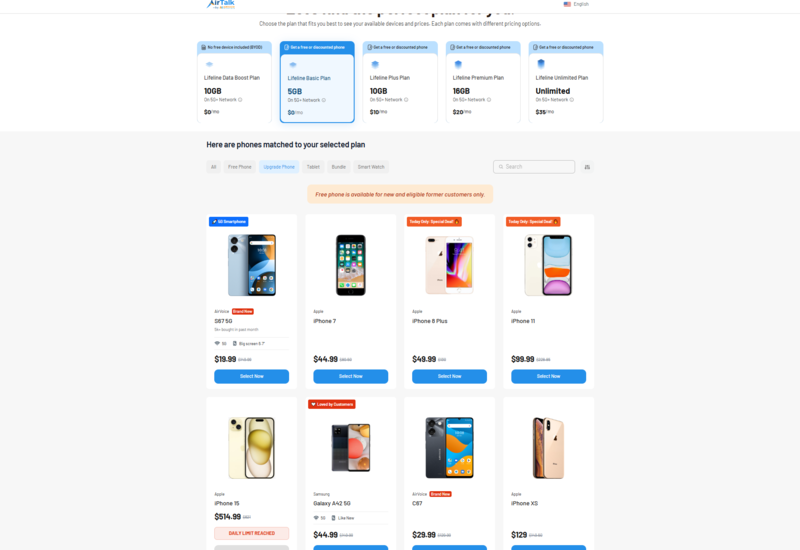
IMPORTANT: The government does not subsidize devices. Lifeline programs cover basic service costs only. Free or discounted devices, upgrade plans, or top-ups are exclusive benefits provided by Cintex and AirTalk Wireless as part of promotional offers. Terms and conditions apply. Limited-time promotion—offers vary by state, stock availability, and eligibility.
6. Frequently Asked Questions (FAQ)
Q1. Can Virginia Medicaid Recipients Apply for Nursing Homes for Dementia Patients?
Yes. Virginia Medicaid may cover nursing facility care for dementia patients in Medicaid-certified facilities if medical and financial requirements are met
Q2. Does Virginia Check Assets for Medicaid Eligibility?
No, for most applicants. Adults ages 19 to 64, children, parents, and pregnant individuals face no asset test under Cardinal Care. Asset limits apply only to ABD Medicaid, Nursing Home Medicaid, and CCC+ Waiver applicants, where the countable asset limit is $2,000 for a single individual.
Q3. What Is FAMIS and How Is It Different From Virginia Medicaid?
FAMIS is Virginia’s Children’s Health Insurance Program. It covers children under 19 whose household income is too high for standard Medicaid but at or below 205% FPL. FAMIS has no premiums, co-pays, or deductibles and provides 12 months of continuous coverage. Virginia generally uses the same application process to evaluate eligibility for both Medicaid and FAMIS.
Final Words
Virginia Medicaid eligibility covers a wider range of residents than most people expect. Cardinal Care includes working adults up to 138% FPL, children through FAMIS at up to 205% FPL, and seniors through MABD and CCC+ Waiver pathways.
No asset test applies to most applicants. There is no enrollment period; you can apply at any time of the year.
If you already have Virginia Medicaid, let’s check your Lifeline benefits at Cintex Wireless or AirTalk Wireless.